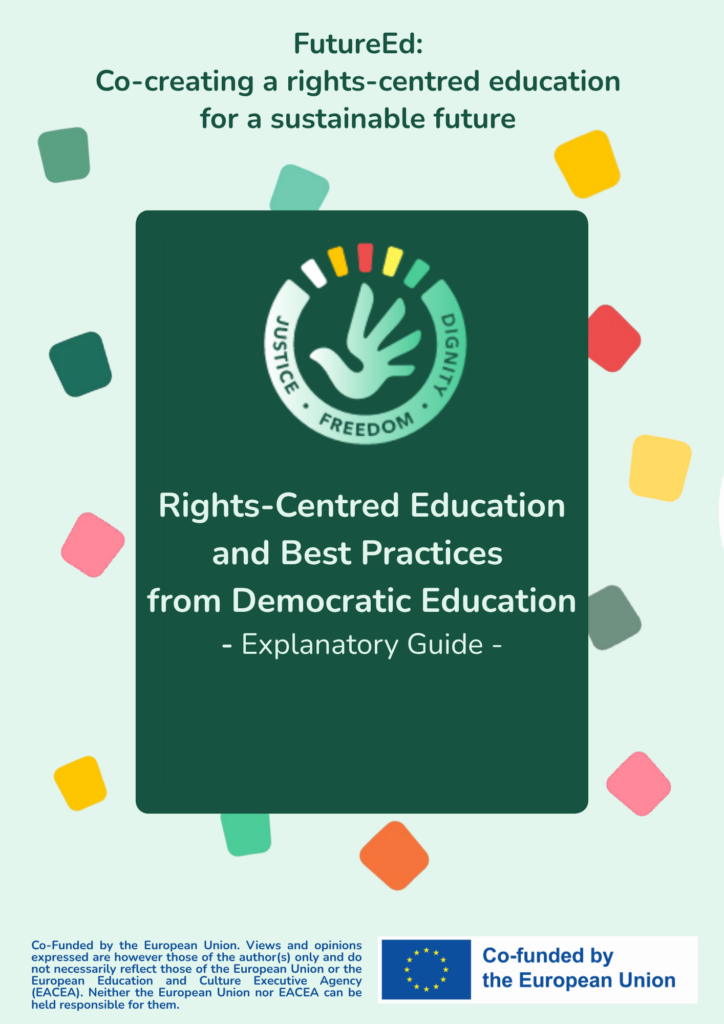
A practical guide to help schools embed Human Rights, democratic participation and self-determined learning into everyday educational practice, through inspiring examples from democratic schools, practical implementation strategies and a School Self-Assessment Tool for reflection and continuous improvement.
From Human Rights to Everyday School Practice
How can schools move from teaching about human rights to living them every day?
This question inspired the development of Rights-Centred Education: Best Practices from Democratic Education, a new guide developed by EUDEC – European Democratic Education Community within the FutureEd Project, co-funded by the European Union through the Erasmus+ Programme.
Drawing on decades of experience from Democratic Schools across and beyond Europe, the guide explores how schools can embed human dignity, participation, inclusion and self-determined learning into everyday educational practice. Rather than presenting democratic education as a separate methodology, it demonstrates how democratic principles can help schools create learning environments where children’s rights are genuinely experienced, not only taught.
Who is this guide for?
- School leaders
- Teachers and educators
- Students and young people
- Parents and families
- Teacher trainers and researchers
- Policymakers and educational organisations
- Anyone interested in Rights-Centred and Democratic Education
What will you find in this guide?
This guide is not a recipe to follow, but an invitation to reflect, adapt and strengthen educational practices that place human dignity, participation and children’s rights at the heart of school life.
- Foundations of Rights-Centred Education and its connection to International Human Rights frameworks.
- EUDEC’s Democratic Education Approach, based on self-directed learning and democratic governance.
- Best practices from Democratic Schools across and beyond Europe.
- Practical guidance for implementing rights-centred education in different educational contexts.
- Reflections on curriculum, participation and educational policy.
- Annex 1, School/Teachers Self-Assessment Tool, supporting schools in reflecting on their own practices and identifying opportunities for further development.
A Practical Tool for Your School Community
One of the key features of the guide is Annex 1 – The School Self-Assessment Tool
Rather than evaluating schools against a fixed model, the tool encourages collaborative reflection among teachers, school leaders, students and, where appropriate, families. It can be used to identify strengths, stimulate dialogue and inspire practical actions towards more participatory, inclusive and rights-respecting learning environments.
There is no single path to democratic education. The School Self-Assessment Tool is designed to help every school reflect, grow and develop at its own pace.
Questions or feedback?
We would love to hear how you use the guide in your educational context.
📧 Contact us at: info@eudec.org
About FutureEd
This guide was developed by EUDEC e.V (European Democratic Education Community) within the FutureEd Project, in collaboration with ALLI asbl and CollectiveUP.
FutureEd supports educators in strengthening human rights, democratic participation and digital citizenship through practical educational resources and European cooperation.
Views and opinions expressed are, however, those of the author(s) only and do not necessarily reflect those of the European Union or the European Education and Culture Executive Agency (EACEA). Neither the European Union nor EACEA can be held responsible for them.